does humor belong in art? Frank Zappa
I drew this in 2004. I sometimes like a good chuckle as it helps release the stress of being an "artiste"
does humor belong in art? Frank Zappa As a child I had an obsession with American Indians. (I always wanted the Indians to beat the cowboys on TV) I used to find arrow heads on the farm I grew up on. There was a baseball field near our farm and I could hear the people screaming sometimes---My dad told me it was Indians and I believed him for years. I have some American Indian blood in me. There was a joke among certain friends of mine that it was impossible to "sneak up" on me when we were growing up. Perhaps that is genetic and accounts for my love of fire water when I was in my twenties. "Nowadays" I dont go out--I stay in my apt and draw and paint.
 To see a World in a grain of sand,
 Here is a not-so- great photo of my "great bread." The detail is lost but I will re-shoot. I want to tone down the reddish brown as well. I am trying to get my bread to have an "inner light" and to bring life to the mundane. It is only half-painted (or baked) at this point..


 Sometimes, when you are under deadline pressure and your primary yellow paint doesnt want to open and you have a really bad headache--- You can squeeze the tube harder to try to unblock the dried paint that is clogging the tube. Hopefully you are standing close to your favorite art books when the bomb goes off. If I had bad "modern art" books I could leave the spattered mess on and call it art.


 George Edward Woodberry - "Defeat is not the worst of failures. Not to have tried is the true failure."


Frederic Edwin Church (May 4, 1826 – April 7, 1900) was an American landscape painter born in Hartford, Connecticut. He was a central figure in the Hudson River School of American landscape painters. While committed to the natural sciences, he was "always concerned with including a spiritual dimension in his works".[1]
The wealth of Church's father allowed him to pursue his interest in art from a very early age. At eighteen years of age, Church became the pupil of Thomas Cole in Catskill, New York after Daniel Wadsworth, a family neighbor and founder of the Wadsworth Atheneum, intoduced the two. In May of 1848, Church was elected as the youngest Associate of the National Academy of Design and was promoted to Academician the following year. Soon after, he sold his first major work to Hartford's Wadsworth Atheneum.
Church settled in New York where he taught his first pupil, William James Stillman. From the spring to autumn each year Church would travel, often by foot, sketching. He returned each winter to paint and to sell his work.


I once was asked by a children's book agent to draw him a bunny as a kind of art test. I don't really draw happy furry bunnies so I sent this drawing along with the poem you will find below..
You asked that I draw you a bunny
And a bunny, my friend, you did get
When I started it was pleasant and sunny
But soon it was cloudy and wet
I waited in vain for the sunshine
But the gold eye of heaven showed not!
What kind of agent would be mine?
When my bunny is wet as a sot?
I tried and I dried all the wet fur
So my bunny was fluffy and new
But nothing quite seemed to work, sir
So what was an artist to do?
I went straight down to
Where I knew there a drier or three
And I fluffed up my bunny, hurray
And drew him once more for thee…

 Here is a bad photo of a loaf of bread I am painting. It has been years since I painted some of the basics. Bread is as timeless as painting as a motif. I plan to make this into a damn good piece of art and not be lazy. The structure is not bad, if you do not have structure you have a bad home that you shouldnt waste your wallpaper on. it is nice to have the oils flowing again and work on canvas as well.
 This car is for sale on ebay. It is around $500,000.00 last time I checked. If I ever get rich as Picasso or Dali I will buy this.

 This is one the great images ever made. It is the "Great Wave" and part of a series of 36 views of Mt. Fuji.
 Here is a photo of one of my favorite artists. For once I am not going to elaborate on an artist. I am going to let you google to find out about this great and demented genius.


 I had a dream about Vienna last night. I have never been there. I woke up this morning and painted this--- a spiritual watercolor of a city I have never visited.


 This image is explained in posting below. this reminds me of an angel, a magnetic angel.


 SOLD
SOLD Here is a great photo of a lava flow in Kilauea Hawaii. This reminds me of the mouth of hell as it is depicted in many old Flemish paintings and by the Bosch "school of art".
 I have totally given up watching television. I got rid of mine and I often miss it. I feel that I have to replace the "zombie time" with other things to keep me occupied. FYI, it is a little known fact that the flicker rate of a television was optimized to create an hypnotic effect in humans----Increase flicker rate and you can bring on epileptic seizures.
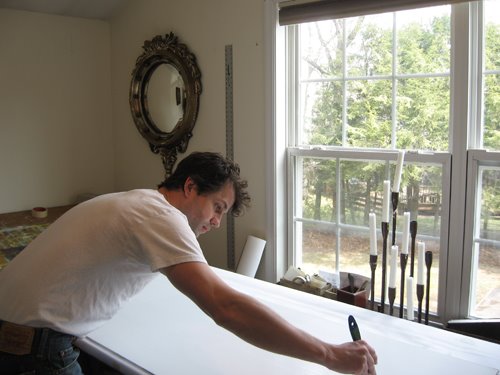
 I finally attacked my 20 dollar sheet of watercolor paper (22 x 30 inches). It is nice to work with good quality paper and supplies. I finished this last night at 3am and this is a really bad photo and I must re-shoot tonight. This piece is concerned with and influenced by the novel "the other side" by Alfred Kubin. It is influenced by that novel in spirit, not in a direct visual fashion to the story line. I chose the name for this piece the ghost of Renoir because it brings to mind the paintings of Renoir's women with umbrellas. I wish I had a better photo but I am off to Brooklyn and I have no time to re-shoot.
 Today humanity, as never before, is split into two apparently irreconcilable halves.
The psychological rule says that when an inner situation is not made conscious, it happens outside, as fate.
That is to say, when the individual remains undivided and does not become conscious of his inner contradictions, the world must perforce act out the conflict and be torn into opposite halves.
– C.G. Jung, 1959